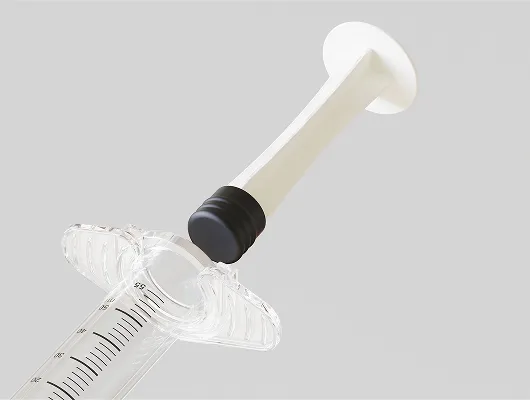
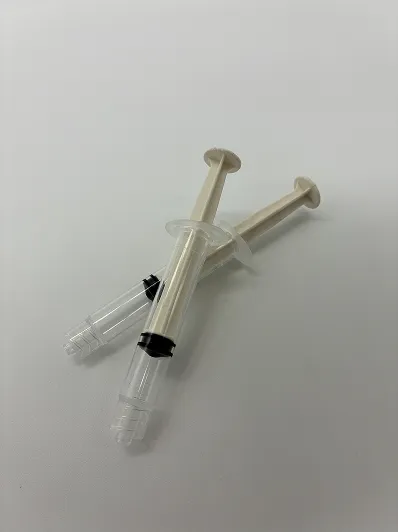
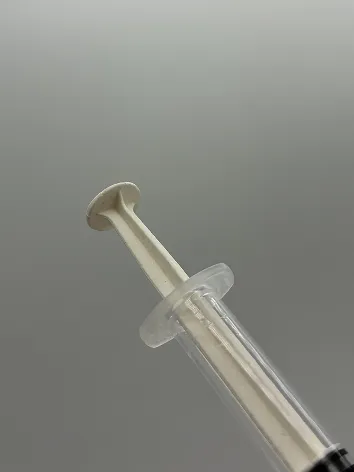
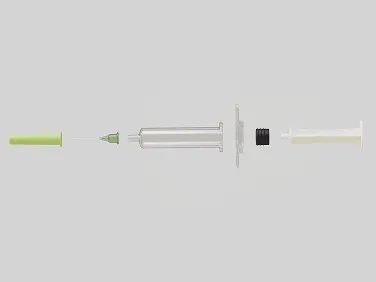
Pulp-Based Plunger Rod
Plunger rods require stable geometry and sufficient mechanical strength to ensure reliable drug delivery and compatibility with automated assembly systems.
Compared to conventional fibre-based processes, Pulp-Injection achieves enhanced dimensional consistency, enabling its use in functional components.
The material also generates minimal fibre dust, supporting clean manufacturing environments and reducing contamination risks.
At the same time, its pulp-based composition allows integration into existing paper recycling streams, contributing to more sustainable device design.
Solution
Client
Lancement
Les raisons de ce choix
We were looking for a way to replace petroleum-based plastic components in syringes while maintaining essential functionality.
In such applications, components are typically single-use for hygiene reasons, which contributes significantly to plastic waste.
Conventional fibre-based solutions often lack the dimensional stability required for functional parts, limiting their application.
By overcoming these limitations, this solution enables a meaningful reduction of single-use plastics within our applications.
Single-use plastic components remain standard in syringes due to their reliability and process compatibility. However, increasing regulatory pressure and sustainability commitments are accelerating the search for alternative materials. In this project, the challenge was to develop a plunger rod that meets key functional requirements—such as stable geometry, mechanical integrity, and compatibility with automated assembly. With Pulp-Injection, we created a component that bridges the gap between conventional fibre materials and functional requirements. This demonstrates that pulp-based solutions can go beyond secondary packaging and be applied to functional components in pharmaceutical systems.
Études de cas en vedette


Prêt à commencer à travailler avec nous ?
Chez Nissha, nous vous aiderons à chaque étape !