Tailored Packaging Solutions, Just for You



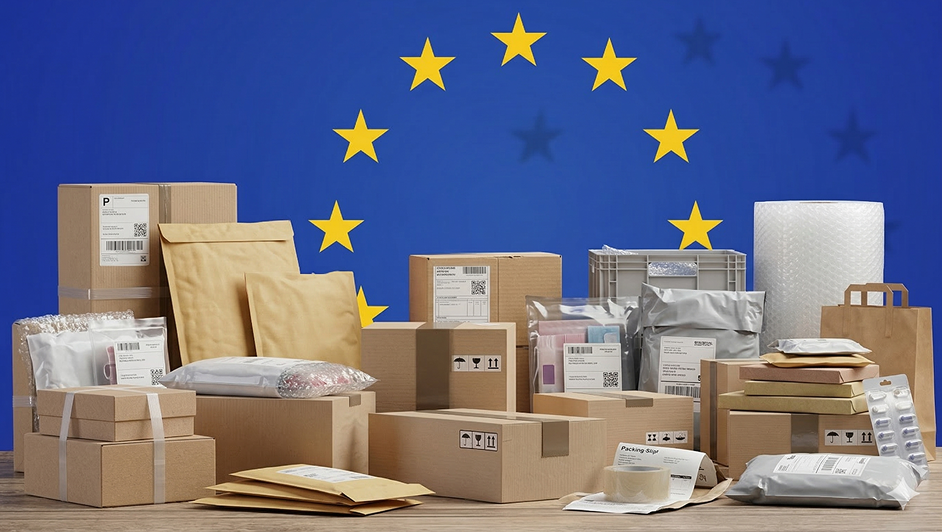
Explore the latest EU packaging regulations for 2026, focused on sustainability, recyclability, waste reduction, and circular economy compliance.
Tailored Packaging Solutions, Just for You
Packaging affects far more than product protection. For companies placing products on the EU market, it influences material use, logistics, cost, product safety, and overall compliance obligations.
That matters even more as sustainability in packaging becomes increasingly shaped by binding European Union rules, not only by voluntary environmental goals. Businesses now need to think beyond packaging performance alone and consider how packaging is designed, used, and managed throughout its lifecycle.
With stricter EU packaging requirements starting to apply from 2026 onward, packaging is becoming a more important part of compliance planning, operational readiness, and long-term business strategy.
That’s why today, we’re breaking down everything you need to know about current and future European Union packaging regulations.
The current EU rules on packaging are still primarily based on Directive 94/62/EC on packaging and packaging waste, which applies to all packaging placed on the EU market and all packaging waste, regardless of material or industry.

Its purpose is to reduce the environmental impact of packaging while supporting the functioning of the EU internal market.
At the core of the directive are essential requirements for packaging design and composition:
The framework also sets rules related to waste prevention and waste management performance, meaning packaging compliance goes beyond the pack itself and includes consideration of how packaging will be handled at end of life.
Stay in line with current and future regulations with our solutions
Discover packaging formats developed with traceable sourcing, responsible material choices, and disposal routes suited to real market conditions.
Although the current framework established the basis for packaging compliance in Europe, the market and regulatory context have changed significantly since it was introduced.
Packaging waste volumes in the EU have continued to rise, driven by factors such as e-commerce growth, single-use packaging formats, and higher consumption levels.
This has increased pressure on the existing system and made stronger action on waste reduction, recyclability, and circular resource use more important.
Not only that, but because Directive 94/62/EC is a directive rather than a regulation, each Member State has implemented it through national law. As a result, the overall framework is EU-wide, but many compliance obligations are still handled at country level.
For companies operating in several EU markets, this often creates differences in producer responsibility registration, reporting, labeling expectations, waste-management obligations, and enforcement practices.
Together, these pressures have increased the need for a more modern and harmonized EU eco-friendly packaging framework.
The most important upcoming change in EU packaging law is Regulation (EU) 2025/40 on packaging and packaging waste, also known as the Packaging and Packaging Waste Regulation (PPWR).
Unlike the previous framework, the PPWR is a directly applicable EU regulation rather than a directive. This creates a more uniform legal basis for packaging requirements across Member States.

The regulation covers the full packaging lifecycle, including design, material composition, labeling, placing packaging on the market, waste prevention, reuse, and waste management.
It applies broadly to businesses placing packaging or packaged products on the EU market, including packaging manufacturers, brands, importers, distributors, and retailers.
Regulation (EU) 2025/40 or PPWR entered into force on 11 February 2025.
However, most of its provisions will generally apply from 12 August 2026, which is the main date businesses should consider the start of the new EU packaging framework.
But keep in mind that the PPWR is not a single-date compliance change.
While the regulation starts applying from August 2026, some obligations, technical requirements, and targets are phased in over the following years, with several important measures taking effect between 2026 and 2030.
For businesses, that timing matters. Packaging changes often involve development lead times, supplier coordination, testing, approvals, production adjustments, and stock planning. As a result, waiting until a legal deadline is close may leave too little room to adapt efficiently.
Get ahead of the changes
Align your packaging with upcoming EU requirements and practical market needs.
For many businesses, the real question is not just what the PPWR is, but what it will actually change in practice. And the answer is: quite a lot.
From packaging design and material choices to labeling, producer obligations, and market access, the new regulation affects several parts of the packaging process.

Under the PPWR, packaging design becomes a much more direct compliance issue. The regulation introduces stricter requirements, which means businesses will need to assess packaging performance much earlier in the development process.
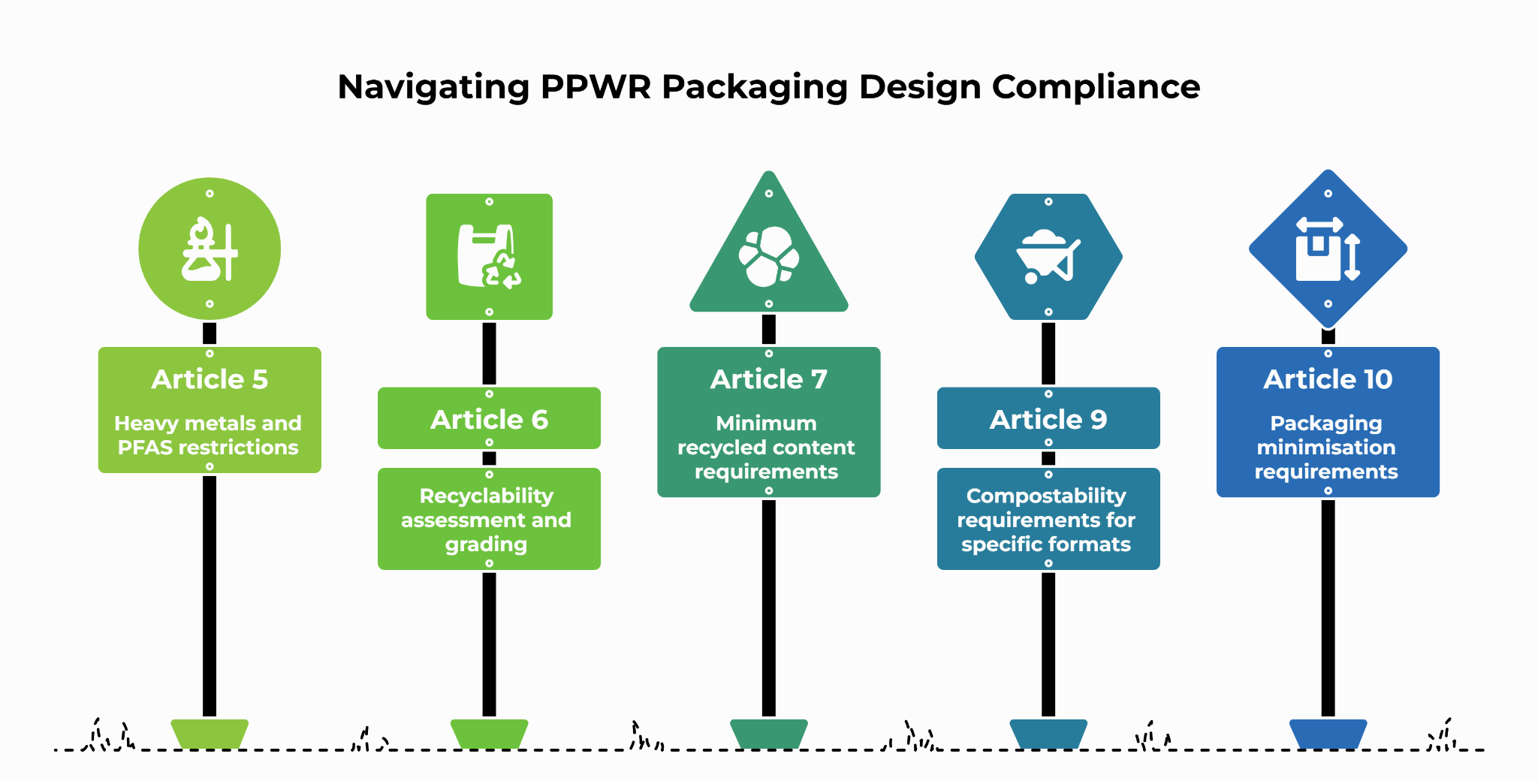
To make the regulation easier to navigate, we’ve highlighted the main design requirements businesses should know.
Article 5 keeps the combined limit of 100 mg/kg for lead, cadmium, mercury, and hexavalent chromium in packaging. It also introduces restrictions on PFAS in food-contact packaging, adding a new material-safety consideration for businesses using food-contact formats.
Article 6 requires packaging placed on the EU market to be recyclable. Under Annex II, recyclability is not assessed only by material type, but also by whether the packaging can be separately collected, sorted within existing recycling systems, and recycled in practice.
Packaging is graded based on recyclability performance grade based on the share of the packaging unit, by weight, that is considered recyclable. Grade A applies where at least 95% of the packaging unit by weight is recyclable, Grade B where the recyclable share is at least 80%, and Grade C where the recyclable share is at least 70%. From 2030, packaging will generally need to achieve at least Grade C to remain on the market, and from 2038, the threshold tightens further so that only Grades A and B will remain acceptable.
Article 7 introduces minimum recycled content requirements for plastic packaging from 1 January 2030. The required percentages vary by packaging type, with targets generally ranging from 10% to 35% depending on the application.
Learn more about how businesses are successfully reducing their plastic footprint
Article 9 sets compostability requirements for specific packaging formats. These include items such as tea bags, coffee pods, sticky labels attached to fruit and vegetables, and certain very lightweight plastic carrier bags, which must meet the relevant compostability conditions under the regulation.
Article 10 introduces packaging minimisation requirements, meaning packaging weight and volume must be limited to what is strictly necessary for functionality. This also includes restrictions on unnecessary empty space and oversized packaging formats that create avoidable waste.
Another important change under the PPWR is that some packaging formats will be restricted entirely, not just redesigned.
From 1 January 2030, economic operators will no longer be allowed to place specific packaging formats listed in Annex V of the regulation on the EU market. These restrictions mainly affect certain single-use packaging formats used in sectors such as hospitality, food service, and retail.
For businesses in affected categories, this means compliance may require more than adjusting existing packaging. In some cases, it may involve moving to alternative formats entirely, which makes early planning especially important.
The PPWR also introduces more consistent rules for how packaging is labelled and identified across the EU.
Under the new framework, packaging will need to provide clearer information on material composition and sorting, using standardised labelling that will be further defined through Commission implementing acts. The aim is to make packaging information easier for consumers to understand and more consistent across EU markets.
The regulation also allows for digital carriers such as QR codes to provide additional information, including disposal guidance, sorting instructions, and details on individual packaging components where relevant.

Traceability is another important part of the new system. Packaging must include the necessary manufacturer or importer identification details so the responsible economic operator can be identified more easily across the EU market.
In addition, reusable packaging must be clearly labeled as reusable to distinguish it from single-use formats.
Sustainability messaging around packaging is becoming more tightly regulated. Businesses will need to be more careful about how they describe environmental benefits and avoid claims that are too broad, vague, or misleading.
Any claim made about packaging will need to clearly explain what it refers to. That could be one specific component, the full packaging unit, or a wider packaging portfolio placed on the market. This means companies will no longer be able to rely on general wording that makes packaging appear more sustainable than it actually is.
This reflects a broader EU push for greater transparency and stricter control of greenwashing.
For businesses, the takeaway is clear: packaging claims will need to be more specific, more evidence-based, and more closely tied to actual packaging performance.
Another important area of change is producer responsibility. The new framework takes a broader view of who counts as a producer, which may include manufacturers, importers, distributors, and other economic operators depending on how packaging is placed on the market.
When packaging or packaged products are placed on the market in a Member State for the first time, the responsible party will need to register in the relevant national producer register. This also includes reporting packaging types and quantities and keeping that information up to date.
The rules also reinforce Extended Producer Responsibility (EPR). In practice, this means producers are expected to contribute financially to the systems that manage packaging waste, including collection, sorting, labelling-related systems, and data reporting.
For businesses operating across multiple markets, this makes producer responsibility a more visible and practical part of packaging compliance.
Packaging that works harder for your team
From Pulp-Injection and Fiber-Forming to PaperFoam® and Sulapac®, our solutions help make multi-market compliance easier to manage.
Responsibility under the new framework does not stop with the packaging manufacturer. A wider range of businesses involved in placing packaging on the EU market will also need to meet specific compliance obligations.
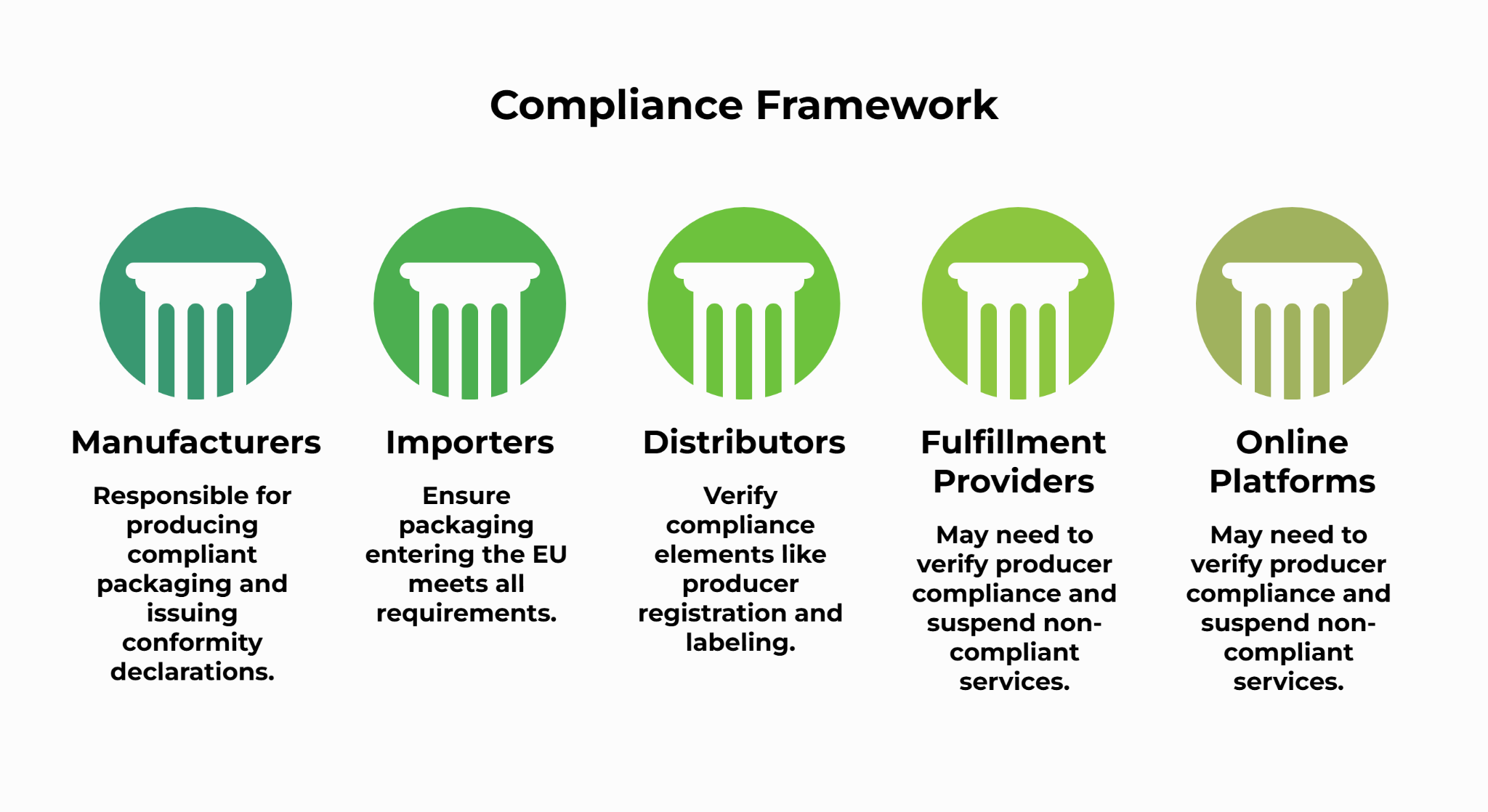
Manufacturers may only place compliant packaging on the market and must carry out the required conformity assessments and issue declarations of conformity.
Importers are responsible for ensuring that packaging entering the EU from third countries meets all applicable requirements before it is made available on the market.
Distributors must also act with due care. In practice, that means checking that key compliance elements are in place, such as producer registration, correct labeling, and traceability information.
The framework also extends to fulfillment service providers and online platforms.
These businesses may need to verify that producers meet relevant compliance obligations and, in some cases, may be required to suspend services related to non-compliant packaging.
So, let’s recap. Here is a quick checklist of what businesses should start reviewing under the new EU packaging rules:
Preparing for the new EU packaging rules requires more than regulatory awareness.
Based on our experience supporting companies with packaging material selection, format evaluation, and the transition toward more sustainable packaging solutions, there are a few key areas businesses should review first.
Below, we’ve prepared a practical step-by-step framework to help you assess readiness and plan ahead.
Start by identifying all packaging formats your business places on the EU market. That includes primary, secondary, and transport packaging, as well as the materials used and the countries where each packaging type is sold or distributed.
This creates a clear view of what falls within scope and where obligations may apply.
Review your current packaging against the main areas likely to affect compliance. This should include recyclability, packaging minimisation, empty space limits, substance restrictions, labelling and traceability requirements, and any format-specific restrictions that may apply in the future.
The goal at this stage is to identify where current packaging already aligns and where changes may be needed.
Compliance will depend not only on your packaging choices, but also on whether your suppliers can support them. Review whether suppliers can provide recyclable material options, technical documentation, traceability data, and the information needed to support regulatory requirements.
This is often the point where businesses begin working more closely with sustainable packaging partners whose solutions are already better aligned with current and upcoming EU requirements.
Start with packaging that is already aligned
Take advantage of our sustainable packaging formats such as Fiber-Forming, designed for full paper recyclability (Grade A), and Pulp-Injection, developed with Grade B targets in mind.
Determine which legal entity qualifies as the producer in each market scenario and what that means in practice for registration, reporting, and Extended Producer Responsibility obligations.
This is especially important for businesses operating across several Member States, where producer roles and compliance workflows may need to be managed carefully.
Once the main risks are clear, create a roadmap for transition. Identify high-risk packaging formats, prioritise the areas most likely to need redesign or replacement, and set internal deadlines ahead of regulatory milestones.
Early planning helps reduce the risk of approval delays, supply chain disruption, and last-minute packaging changes.
The final step is to move toward packaging solutions that are better aligned with upcoming requirements while continuing to monitor regulatory developments over time.
That includes not only implementing more recyclable and sustainability-aligned packaging, but also keeping track of future Commission implementing acts, technical criteria, and labelling requirements that may further shape compliance expectations.
For companies navigating the transition to EU-compliant packaging, working with experienced providers of sustainable packaging solutions can simplify compliance while supporting long-term environmental and business goals.
Explore our sustainable packaging solutions designed to align with current and upcoming EU regulations.
The new EU packaging rules are not just another regulatory update. They are a clear signal that packaging is becoming a much bigger business priority.
As Regulation (EU) 2025/40 reshapes the market, packaging decisions will play a bigger role in compliance, market access, operational planning, and long-term resilience. What was once treated mainly as a packaging or procurement issue is becoming something much more strategic.
That is why businesses that start early are likely to be in a stronger position. They have more time to review formats, work through redesigns, align with suppliers, and make better decisions before regulatory pressure becomes more immediate.
Done well, packaging compliance can help your business stay ahead.
Packaging solutions built around your goals
Explore sustainable packaging solutions designed to support compliance, performance, and long-term business goals.
Does the PPWR apply to companies outside the EU?
Yes. The regulation is relevant not only to EU-based businesses, but also to companies outside the EU that place packaged products on the EU market. That means non-EU manufacturers, exporters, and brand owners may also need to review their packaging to meet the new requirements.
Will all packaging need to be redesigned under the PPWR?
Not necessarily. Some businesses may only need to make targeted adjustments, while others may need broader changes to materials, formats, or labelling. The impact depends on the type of packaging used, the markets involved, and how well current packaging already aligns with upcoming requirements.
Which industries will be most affected by the new EU packaging rules?
The regulation applies across industries, but the impact may be more significant in sectors that rely heavily on single-use packaging, plastic packaging, food-contact packaging, or cross-border distribution. This can include industries such as food and beverage, cosmetics, personal care, retail, and e-commerce.
Can sustainable packaging also support compliance with the PPWR?
In many cases, yes. Packaging designed for recyclability, material efficiency, and lower environmental impact may already be better positioned for alignment with future requirements. However, sustainability claims alone are not enough. Packaging still needs to meet the relevant legal and technical criteria.
Why should businesses start preparing before 2026?
Because packaging changes rarely happen overnight. Redesigning packaging often involves supplier coordination, testing, approvals, lead times, and market-by-market planning. Starting earlier gives businesses more flexibility and reduces the risk of rushed decisions later.
How can businesses assess whether their packaging is PPWR-ready?
A good starting point is to review packaging against the main areas covered by the regulation, including materials, recyclability, format restrictions, labelling, traceability, producer responsibility, and supplier readiness. This helps identify which packaging formats are already aligned and which may need further action.


Chez Nissha, nous vous aiderons à chaque étape !